Visualizations
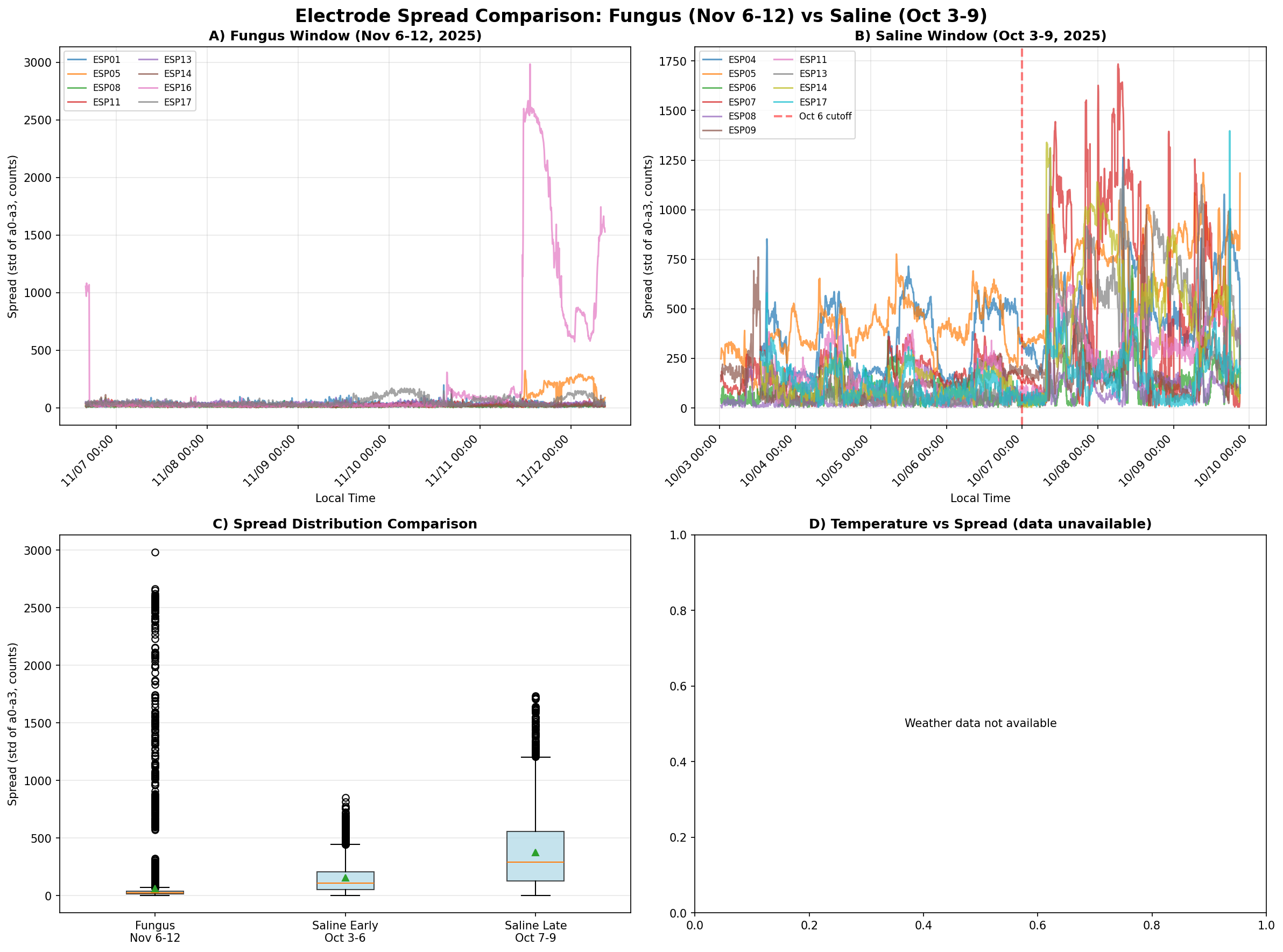
| ESP | N (5-min) | Mean | P95 | P99 | Max | >150 | >300 | % >150 | % >300 |
|---|---|---|---|---|---|---|---|---|---|
| ESP01 | 1,644 | 33.2 | 61.2 | 84.9 | 197.8 | 2 | 0 | 0.1% | 0.0% |
| ESP05 | 1,644 | 49.5 | 234.4 | 272.7 | 322.6 | 165 | 2 | 10.0% | 0.1% |
| ESP08 | 1,644 | 15.6 | 28.3 | 41.8 | 89.8 | 0 | 0 | 0.0% | 0.0% |
| ESP11 | 1,643 | 30.6 | 50.7 | 61.9 | 81.6 | 0 | 0 | 0.0% | 0.0% |
| ESP13 | 1,644 | 35.1 | 55.6 | 68.4 | 90.8 | 0 | 0 | 0.0% | 0.0% |
| ESP14 | 1,644 | 20.0 | 37.3 | 50.6 | 162.6 | 1 | 0 | 0.1% | 0.0% |
| ESP16 | 1,644 | 268.2 | 1925.8 | 2575.3 | 2984.2 | 298 | 277 | 18.1% | 16.8% |
| ESP17 | 1,644 | 54.3 | 134.5 | 158.9 | 170.3 | 28 | 0 | 1.7% | 0.0% |
| ESP | N (5-min) | Mean | P95 | P99 | Max | >150 | >300 | % >150 | % >300 |
|---|---|---|---|---|---|---|---|---|---|
| ESP04 | 1,828 | 385.8 | 761.8 | 890.7 | 1263.8 | 1,689 | 1,125 | 92.4% | 61.5% |
| ESP05 | 1,977 | 524.5 | 920.1 | 1030.3 | 1187.4 | 1,916 | 1,715 | 96.9% | 86.7% |
| ESP06 | 1,976 | 101.5 | 251.1 | 378.6 | 718.2 | 443 | 48 | 22.4% | 2.4% |
| ESP07 | 1,977 | 332.6 | 1162.3 | 1544.5 | 1734.3 | 1,174 | 564 | 59.4% | 28.5% |
| ESP08 | 1,977 | 73.4 | 180.8 | 265.0 | 405.3 | 265 | 6 | 13.4% | 0.3% |
| ESP09 | 1,977 | 171.5 | 400.9 | 735.2 | 1003.9 | 894 | 198 | 45.2% | 10.0% |
| ESP11 | 1,828 | 224.6 | 500.0 | 587.9 | 624.9 | 1,075 | 610 | 58.8% | 33.4% |
| ESP13 | 1,828 | 269.0 | 852.3 | 1041.1 | 1309.4 | 777 | 660 | 42.5% | 36.1% |
| ESP14 | 1,828 | 303.9 | 963.6 | 1135.9 | 1339.3 | 1,036 | 643 | 56.7% | 35.2% |
| ESP17 | 1,828 | 140.7 | 327.9 | 452.2 | 1397.6 | 722 | 131 | 39.5% | 7.2% |
NO — Most fungus spreads are significantly lower than saline, but ESP16 shows extreme outliers (max 2984 counts) that exceed saline late period. This suggests: (1) typical fungal spreads are biological and much tighter than environmental artifacts; (2) ESP16's extreme episodes are a special case requiring separate investigation.
The 001B report states: 'The transient increases in fungus (like ESP05's 176-count episode) are comparable to saline's late-day spreads, suggesting both reflect interface/environmental shifts rather than biological state changes.'
REFUTES: Fungus spreads are significantly different from saline late period (p=0.00e+00), suggesting different mechanisms or additional biological contributions.
Experiment 001B documented electrode spread patterns (standard deviation across a0–a3) in the living fungus baseline. The 001B report stated that "transient increases in fungus (like ESP05's 176-count episode) are comparable to saline's late-day spreads, suggesting both reflect interface/environmental shifts rather than biological state changes." This claim needed rigorous quantitative validation:
Step 1: Data Extraction
esp01_experiment_001a.csv through esp17_experiment_001a.csv (8 ESPs total: esp01, esp05, esp08, esp11, esp13, esp14, esp16, esp17).esp04_saline_per_electrode.csv through esp17_saline_per_electrode.csv (10 ESPs total).Step 2: Resampling (Matching 001B Method)
resample("5min").median().Step 3: Spread Calculation
std(axis=1) across the four electrode channels.Step 4: Summary Statistics
Step 5: Statistical Comparison
Step 6: Temperature Correlation (Saline Period)
/data/weather_oct2025.parquet) to compute Pearson correlation between daily max temperature and daily mean spread for saline period.Analysis performed using: analysis/fungal_state_mapping/scripts/compare_fungus_vs_saline_spread.py